Book review: The Museum: A Short History of Crisis and Resilience
Article DOI: https://dx.doi.org/10.15180/252402
Abstract
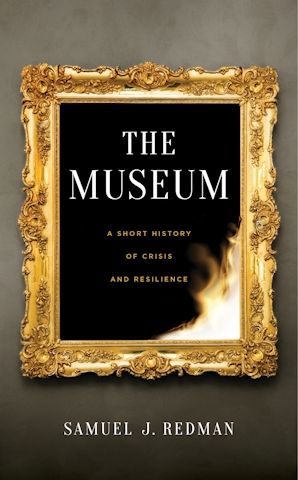
Thomas Mougey reviews The Museum: A Short History of Crisis and Resilience by Samuel J Redman.
Keywords
museum practice, museums
Review
By emphasising how American museums struggled, survived and eventually thrived through the diverse crises they faced in the twentieth century, Samuel Redman’s compact and accessible study offers a resourceful toolkit for observers and practitioners alike that are interested in tackling the fundamental crises museums have faced and continue to face in the twenty-first century. While the book, first published in 2022, was likely inspired by the Covid-19 pandemic’s impact on museums, it should not be reduced to a study of the pandemic’s effects on museums.
Over just six chapters covering one hundred years (c. 1919–2019), Redman depicts how museums experienced and responded to crisis moments ranging from war to pandemics, to natural disasters, economic depression and public dissent. Chapters 1–3 explore the First World War, the ensuing Spanish flu pandemic, the Great Depression and the Second World War to assess how museums, large and small, fared during such seismic crises. Chapters 4–6 retrace the re-making of the museums as political spaces and objects during the past fifty years, through the Art Strike of 1970, the Culture Wars of the 1980s/1990s and a medley of recent crises, primarily destructive ones including Covid-19, flood and fires to the more constructive types such as Black Lives Matter.
Redman details the discharge of museum personnel, the suspension of exhibitions and the reduction of collections provoked by these crises. Yet the book is not a litany of dramatic museum losses, instead challenging our understanding and perception of crisis moments. Chapter 2 compellingly contests the perception of the Depression era as a period of museum blackout and demonstrates that it was an unexpected period of resilience where New Deal labour prompted a battery of behind-the-scenes transformations that reinforced museums and paradoxically prepared them to flourish in the immediate postwar.
In The Museum, crises are often stimulating moments for shifts in institutional focus. Placing into a longer historical process the outsized discourses of museum shutdown and powerlessness sparked by the Culture Wars of the 1980s and 1990s, chapter 5 demonstrates how museums seized political controversy to innovate and become more broadly relevant to culture beyond the museum. By acknowledging such structural changes as the educative role of museums and their politicisation, Redman convincingly portrays museums as a living idea and as robust and savvy institutions.
These stimulating conclusions largely hinge upon Redman’s multi-level approach to the museum setting. By distinguishing museum discourse from on-the-floor practice while acknowledging the whole spectrum of museum actors, from directors to curators, groundskeepers and visitors, Redman effectively depicts how crises and resilience materialise differently across the museum setting. In so doing, he calls for cautious interpretation of the effects of crises on museums as he demonstrates how crises do not hit, constrain and transform museums uniformly and equally. In chapter 5, Redman takes a critical stance towards the issues of repatriation, historical interpretation and government funding. Although big museums elevated these issues as existential threats to the museum institutions, Redman convincingly demonstrate how museum discourse tends to overshadow the actual threats faced by the bulk of museums (i.e., small and private institutions) stemmed from very different crisis-inducing problems. He goes on to show that this misleading emphasis eclipses how the social issues feared by museum leaders bolstered museum operations by improving transparency in exhibit planning, for instance. Furthermore, emphasising ground operations allows Redman to repeatedly demonstrate how effective responses to crises often stemmed from staffers who, despite their critical role in the continued vitality of museums, appear structurally to be hit first and hardest in times of economic trouble.
By emphasising resilience, Redman also highlights the museum’s responses to crisis situations and highlights its agency in the face of adversity. Throughout the book, effective crisis management appears less as a form of maintenance than as a method of establishing the groundwork for change. Museums are shown to adapt in order to fulfil the social needs of the moment. For example, in chapter 3, as Redman describes how the Smithsonian moved from lethargy during the Second World War by responding to state demands for propaganda and expert knowledge, he explains how war service pushed discussions on the future role of the museum in the postwar. Museum leaders such as Albert Parr designated through war service a new democratic role for museums that entailed some conceptual and practical shifts. Conceptually, with the museum moving from a timeless custodian of truths to a responsive centre defined by current affairs. Organisationally, too, the museum changed, with plans to transform museum practice, through for instance the temporary exhibition which bore a shift from the production to the dissemination of knowledge and citizen education.
Museums generally appear in Redman’s narrative as seamlessly adapting to and transforming through crises. Only too rarely does Redman point out how crisis responses can also come at a cost and may lay the seeds to other internal crises. In chapter 3, Redman indicates how the Smithsonian’s enrolment in the war effort during the Second World War conflicted with the museum’s self-image. Albeit very briefly, Redman points out here how the museum’s direction strived to mitigate the resulting contradictions by framing its war activities as part of its ‘normal functions of diffusion of knowledge’ (p 62). As a result, the shocks and adaptations examined by Redman can at times appear to unfold without much resistance from within the museum and to bear little to no consequences on the nature of the museum idea, the range and balance of its functions and the core missions assigned to the institution.
Crises, however, do not just arise from outside the museum but also from within. How shifts such as Alfred Kroeber’s decision to reinforce research over exhibition at the Hearst Museum during the Great Depression were negotiated within museums and between their core components (e.g., to collect, to study, to conserve, to exhibit) often escapes Redman’s analysis, despite the long-term tensions they represent. For instance, the rhetoric of financial responsibility that appeared in the 1930s lived on and became once more mobilised – and resisted – in the wake of the 1980s neoliberal turn and the ensuing fall in public funding. Redman most often merely describes the problems provoked by crisis-induced choices and eventually falls short of considering that crisis situations could also spring from within the museum.
Nevertheless, The Museum provides a valuable and refreshing account on how museums durably kept themselves relevant to the shifting nature and demands of American society. Redman’s account encourages scholars to conceive crisis as historically consubstantial to museums and as a generative cornerstone of their durability. With museums seemingly muddled in multiple and cumulative crises in recent decades, Redman invites museum practitioners to look with confidence within the museum sector to take stock of its resources, capabilities and ethos to imagine new possibilities through these crises and rebuild the museum’s sense of purpose.
Tags
Author

Media in article