Industrial museums and the potential of anniversaries
Article DOI: https://dx.doi.org/10.15180/252408
Abstract
Oliver Betts (Research Lead, National Railway Museum) reflects on the opportunities for new research opened up by significant museum anniversaries.
Keywords
collaboration, collaborative research, Railway, railway history
Introduction
https://dx.doi.org/10.15180/Anniversaries, particularly big anniversaries like a bicentenary, have a way of focusing the mind. They are, of course, arbitrary in their significance – as Sophie Vohra neatly summarises in her thesis on railway commemoration in Britain (Vohra, 2020). There is no particular reason why a 50th or 100th anniversary should hold greater significance than a 32nd or an 89th, for instance, but as Ludmilla Jordanova has observed, round numbers have a way of capturing public attention when it comes to the past. Significant amounts of time can easily be understood to have passed in a round number like a 200th anniversary, she argues, allowing a collective appreciation of the temporal distance and reflection (Jordanova, 2007). The way that public attention is drawn to significant anniversaries is something that heritage organisations and public history groups have, in recent years, increasingly utilised.
From 2025 onwards a flood of railway bicentenaries will enter the public eye. Starting with the 200-year anniversary of the Stockton and Darlington, built in the industrial north-east of Britain in 1825 and sometimes considered the first ‘modern’ railway, railways spread outwards across Britain, Europe, the Americas and the wider world over the next half-century. The opening of the Liverpool and Manchester Railway in the UK, the Baltimore and Ohio Railroad in the USA, and the Saint-Étienne and Lyon Railway in France will all see their bicentenaries in 2030, and in the 2030s and 2040s the first steam-powered railways in Spain, Ireland, Italy, Poland, Russia, Cuba, Switzerland, Belgium, Austria, the Netherlands and more will see their own 200-year anniversaries. They offer an incredible opportunity to engage a wider public and to move beyond the regular stories told about the origins and early decades of railways.
This essay is an attempt to map out what an innovative and engaging approach to these railway bicentenaries might look like. In doing so, it hopes to engage with wider debates about narrative structure, incorporating new stories, and overcoming the limitations on these in museums, galleries and other heritage spaces. Science and technological museums should, this essay argues, make use of the reflective space of significant anniversaries to move beyond simply retelling the same stories again and again and instead see them as an opportunity to revise and revitalise narratives in ways that make sense to contemporary audiences. It seeks to answer three related questions:
- How can new areas of public interest be brought into anniversary celebrations?
- Can this be done alongside the older stories or must they be replaced?
- Would museums need to navigate negative reaction to this changing of narratives?
Beginning with a discussion of anniversaries in the heritage sector, particularly those relating to technology history, this essay will then go on to consider what different narratives might be developed that speak to contemporary visitor interests and experiences. Finally, in an age of intense public scrutiny of museums and ‘culture wars’ polarisation of views over storytelling perspectives and encounters, this essay will consider what museums could do to navigate reactions to adapting classic narratives in the public eye afforded by a major anniversary year.
Section one: Inventions, traditions and anniversaries
As Britain’s railways enter their bicentenary this year, marking 200 years since the opening journey of the Stockton and Darlington Railway in 1825, railway heritage groups and organisations around the country (and beyond) have been working hard to attract and hold public attention drawn to this milestone. A significant integer in time, however, does not necessarily equate to a significant rethink of the stories told. As Raphael Samuel astutely observed, ‘Popular memory…measures change genealogically, in terms of generations rather than centuries, epochs of decades…it has no developmental sense of time’ (Samuel, 2012). Just because an anniversary marks a set number of decades or centuries does not mean, in the public eye, that it warrants a reconsideration or renegotiation of its key historical ‘story’.
Indeed, recent scholarship on centenaries and other major anniversaries remains divided on whether such round-number events offer much potential for scholarly intervention. Geoff Cubitt and Jessica Moody, in surveys conducted with visitors leaving First World War centennial exhibitions in York and Scarborough, strike a cautious note. They point out that the commemorative elements of the centenary essentially boiled down ‘possible responses into stock formalities’, and that the public were largely resistant to moving beyond established and recognisable tropes that already dominated discussion of the conflict (Cubitt and Moody, 2025). This perhaps gives pause to any conception that an anniversary might lend itself to a revisionist approach to key themes. Certainly, Cubitt and Moody’s findings stand in contrast to the almost bullish optimism with which the First World War historian Gary Sheffield greeted the rejuvenation of interest in the conflict in a 2014 lecture. ‘My hope is that,’ he wrote, ‘at the end of the centenary period the people of Britain will have a more mature, reflective and less strident view of the Great War; one less encumbered by myths, half-truths, prejudice. We should not allow this opportunity to slip through our hands’ (Sheffield, 2014).[1] Shifting the focus of discussion, then, or at the very least enhancing it during an anniversary year, clearly requires a coming-to-grips with the tropes that dominate public perceptions of the event being commemorated.
Whilst museums have become used to a cycle of rethinking and reviewing narratives as tastes, values, information and interpretative strategies change, the temptation to tell the same core stories time and again remains strong, particularly when it comes to notable moments such as anniversaries. There are, after all, many reasons why museums cling to familiar narratives around their collections, through habit and familiarity as much as convenience. John Schofield has highlighted the ways in which systems thinking, undeniably vital to the organisation of big and complicated collections, has nevertheless had a limiting effect on how those collections are used and interpreted by the organisations that hold them (Schofield, 2015. Of equal importance are the ongoing culture wars about the relative importance and value of different interpretations and emphases in telling stories about the past. It is a tension born of what the think-tank British Future defines as ‘an era of increased polarisation around questions of identity, where they are often received differently across generations and ethnic groups, by educational status or political perspective’ (Puddle and Katwala, 2023). The political influences of this conflict, which spill over vividly into debates about the nature and purpose of exhibitions and collections in museums and galleries, does have an unfortunate chilling effect on whether such organisations want to risk new, potentially controversial stories that might generate negative attention. For museums in a controversy-hungry and funding-lean environment, which in the UK has lasted for at least two decades, tried and tested narratives, particularly those known to drive visitor engagement and thus ticket revenue, have an understandable attraction.
This is, however, at odds with both current thinking about visitors and with how visitors themselves think and feel. Since the revolution of the new museology of the 1990s and its placement of the visitor experience at the centre of the museum cosmology, museums have been encouraged to rethink how they tell stories. Visitors bring their own attitudes and assumptions about the past but also intermingled with that are their feelings and knowledge of current events and issues. Drawing parallels or contrasts between contemporary life and culture and different perspectives, be they temporal, cultural or ethical, lies at the core of the visitor experience in museums. This seems particularly important for museums of science and technology, whose collections not only tell stories of past innovation and transformation but are encountered by twenty-first-century visitors themselves experiencing a rapidly changing technological world.
There is a clear hope in the railway heritage sector – already borne out by a flurry of well-attended events, a stream of popular history texts and the commissioning of a number of documentaries – that the major anniversary will draw public attention to the railway past. What is being celebrated in that bicentenary has begun to adhere to three clear yet sympathetic and overlapping narrative structures.
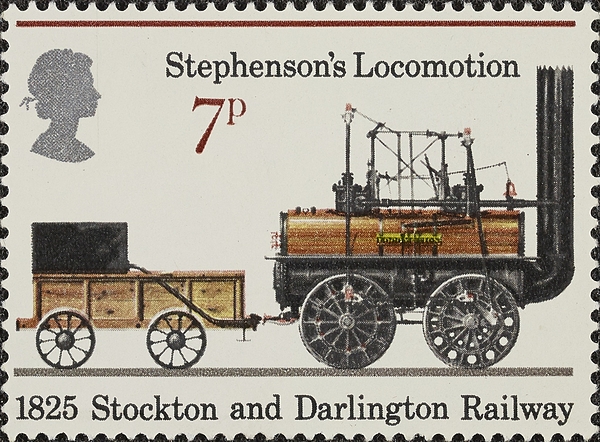
The first, prompted by the anniversary itself, is a focus on the bicentenary of the opening of the Stockton and Darlington Railway. The Stockton and Darlington has been regularly cited as the ‘first’ railway, the ‘birth’ of the industry, and the ‘proof of concept’ that all later railways globally built upon. Designed by George Stephenson and featuring one of his early engines, Locomotion No. 1, its opening day with both cargo and passengers accompanied by waving flags and brass bands provides a perfect historical moment to hang events around. For these reasons, as Vohra has discussed in her thesis, the Stockton and Darlington Railway not only holds a key place in railway history narratives but also in past patterns of commemoration. There has been a long-held desire amongst many passionate about railway heritage for the 2025 celebration to follow in those august footsteps. This is despite, as Vohra vividly shows in her work, a concertina of past, present and future perspectives that complicated previous anniversaries. Both the 1925 and 1975 events were ‘used as a platform to develop narratives about and of the present using the prestige of the past as a means of creating or supporting an identity of those carrying out the commemorative practices’ (Vohra, 2020). In both events cavalcades of locomotives were centrepieces, used to demonstrate not only the early engines of the 1820s but their modern (and, organisers were keen to emphasise, improved) successors. Promoters of the event were torn between the history of 1825 itself and the opportunity to showcase railways as a whole.
This tension helps inform the second of the traditional narrative strands: that the bicentenary of railways should be used to reflect the two hundred-plus-year sweep of railway history. Both Railway 200, the industry organisation overseeing bicentenary events, and the National Railway Museum have embraced this overview approach. For the industry it allows that showcase approach to be taken; timelines can embrace the early railways as the ancient ancestors of a modern railway, always improving and building on stories of success. Across a 200-year span the opening of the East Coast Main Line, for example, can be put on an even par with the introduction of Wi-Fi onto trains, directly emphasising stories of improvement. Similarly, for the National Railway Museum, the overview narrative is a useful one. Busy with a major redesign and mindful of its own 50th anniversary this same year, the sweeping approach works well for a museum wanting to highlight the breadth of its collections. It also allows the museum to reflect the more nuanced critiques of the significance of 1825 – placing it within a wider evolution of steam technology that acknowledges both earlier and later milestones of development. This second approach, then, is best characterised as a timeline of key railway moments spread across more than 200 years, with 1825 being one of a series of milestones leading up to the present day.
Finally, there is of course a third strand of local narrative emerging. Focused on the key towns connected by the Stockton and Darlington Railway – Shildon, Stockton, Darlington, Middlesbrough – but also those places associated with aspects of the early railway (Newcastle, Durham, the wider North-East of England), it doesn’t challenge the prior narratives as much as seek to underline and emphasise key aspects. Darlington, for example, aware of the early railway as one of the key historical events to shape the modern town but also alive to the upswing of money tourism can inject into troubled northern economies, has renovated its railway museum at Hopetown and will be opening an exhibition entitled Railway Pioneers – Celebrating the Railway Rockstars of the Past. ‘Right here at Hopetown Darlington’, the press release enthuses, will be a gathering of early engines from around the country brought to the town to underscore its significance to the national narrative (Hopetown website). Shildon, with its own museum Locomotion, has not only emphasised its place as the starting point of that first 1825 journey but also looks to its own local pioneering figure, engineer Timothy Hackworth, to provide a local perspective on national events. In both cases the aim has not been to challenge conventional wisdom or prevailing narratives as much as to highlight the local elements of those stories, often with a local audience more directly in mind. If in the previous sweeping approach the statement might be that ‘The railways put Darlington on the map’, in this iteration it is Darlington, not railways, that is emphasised.
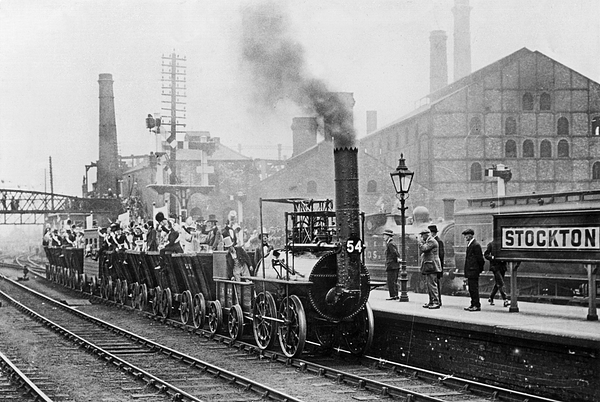
It is not difficult to understand why familiar narratives such as these have so quickly come to the fore in this railway bicentenary. All three feature strong central characters for visitors to engage with, a pivotal sense of historical ‘moment’ to be celebrated, and a clear focus on a specific technology that had a world-affecting legacy. Like many technological stories, the railway one is conveniently telescopic; it can be drawn to a specific focus by a local heritage group celebrating their own aspect of the bicentenary but also capture the wider national impact, impressing visitors with the scope of change being discussed. Moreover, these stories are familiar in a comfortable way. All visitors come to a heritage site with some level of prior knowledge or interest. Whilst the vast majority will not know who George Stephenson was, why Darlington was significant, or when railways began as a technology, some will, and encountering familiar narratives, or at least what fragments of them that they can recall, can be reassuring to visitors. It allows them to build on prior knowledge. Focusing on anniversaries that have a grounding in both the established collection and knowledge base of a museum, for example, avoids the awkward scramble for relevant artefacts that Geoffrey Cubitt notes in the UK bicentenary of the abolition of the slave trade in 2007, where many regional museums struggled to find appropriate objects for display in their collections or elsewise found themselves conflicted over whether to foreground images of atrocities against enslaved peoples (Cubitt, 2011). Familiar narratives drawn from the core collections offer cost-effective, engaging and audience-pleasing ways to mark bicentenaries, and it is thus little wonder why so many museums and heritage sites are keen to follow the path most-trodden.
Section two: New narratives
The opportunity for reflection offered by an anniversary suggests an alternative strategy, one that embraces the chance for new narratives to inform commemoration around this moment of invention. Invention has always been a thorny subject in the history and heritage of technology. Central to how the development of technology has been understood, both by specialists and the wider public, in more recent decades both its academic underpinning and its cultural messaging have become more uncertain. The publication of David Edgerton’s The Shock of the Old in 2006 helped challenge the centrality of the moment of invention, arguing instead that histories of adoption, adaptation and use be more heavily studied (Edgerton, 2008). Allison Marsh, in her review of the Smithsonian’s 2015 Places of Invention exhibition, noted that the design had deliberately moved away from ‘rows of display cases featuring a chronology of inventions that perpetuate the stereotype of the lone inventor genius’ in favour of a more integrated history of collaborative moments of change and development, a move more in keeping with current interpretative trends (Marsh, 2011). Similarly, in recent years the heritage sector has come to question just whose voices are represented in exhibitions but also, in the age of the New Museology, what contemporary issues should be drawn into the past under discussion. ‘Heritage is becoming and must continue to become people-centred’ Schofield argues (Schofield, 2015).
Building on those contemporary issues that audiences seem drawn to, there are three new narrative strands that could be woven into the bicentenary: the connections between the early railways and slavery, the wider international history of the early railway era, and the profound environmental impact the railway age ushered in. None of the three are random; they correspond to wider social concerns and interests mapped out by both visitors and, importantly for the sector, those who currently do not visit. Analysing how each might be woven into anniversary commemoration illustrates how versatile events like bicentenaries can be in incorporating new strands of narrative.
Of the three, narratives of enslavement are perhaps the easiest to incorporate thematically, despite the difficult subject matter. In recent years visitors have grown accustomed to heritage sites complicating narratives by exploring the connections between the people and objects in their collections and systems of transatlantic slavery. The National Trust’s work with Professor Corinne Fowler on the links between enslavement and their collections and properties, and the public impact that had, is one key example.[2] In the railway case it is two-fold: narratives of construction and narratives of implementation.
Stories of construction, so key to the early railway narrative, are fundamental to the story of enslavement. Or, more accurately, the money paid into compensation schemes at the moment of abolition flowed into early railway schemes. This is not new knowledge. Evidence collated in UCL’s Legacies of British Slavery Database shows that key directors and investors, those movers and shakers so instrumental in funding the early and uncertain technology, were operating with huge injections of cash from the emancipation compensation schemes. The concentration of former enslavers in the port cities provided early investment networks for the railways. John Moss (who had received over £40,000 in compensation money) in Liverpool, George Gibbs in Bristol, and William Eccles in Glasgow were all significant financiers in early railway building in the 1830s and 1840s (Legacies of British Slavery Database). Tying these narratives alongside the construction stories, indicating that significant amounts of money flowed from the emancipation paid to slavers and into the early railways, could be as simple as an infographic or an additional clause to an already planned display about a railway’s origins.
Harder to convey are the connections between the implementation of the railways and transatlantic slavery. That some of the goods of early railways, such as the Liverpool and Manchester Railway, were produced by enslaved hands is beyond doubt. Until the outbreak of the American Civil War and the subsequent naval blockade, cotton from slave plantations in the southern United States was unloaded at docks in Liverpool and loaded onto trains bound for the mills of Manchester, spun cotton and pre-made garments returning along the same route. Almost 90 per cent of Manchester cotton travelled this sea and rail route, a figure that easily lends itself to interpretation. What is harder to convey is the rippling out of such a route. That, for instance, the early 1830s saw enslaved hands put to work constructing one of the first American railways in Charleston, South Carolina, to help facilitate the flow of goods through that harbour and into the Atlantic network. Or that, whilst not slave-owners themselves, many of those merchants dealing in goods produced by unfree labour saw the railways as a means to maximise their access to those goods. These stories are more complex, contextual ones, requiring more care in how they are laid alongside existing narratives.
The second of the new narratives presents different challenges. Less controversial than the discussion of slavery and the railways, the international reach of the Britain’s early railways presents the challenge of scale and scope for heritage storytellers. From the early nineteenth century, the railway revolution rippled outwards from Britain. It first found purchase in countries like France, Belgium and the United States, where steam power had also been experimented with as a means of locomotion. From there it spread to other countries and continents, quickly transforming land-based travel in the second half of the century. British engineers and manufacturers fuelled this explosive growth, with many of the first engines (and their crews) in other countries coming from Britain. Foreign engineers, politicians and sightseers also made a point of visiting railways in Britain in the period, placing early railway sites such as the Stockton and Darlington Railway on a global stage. Very quickly a discussion of this narrative strand expands the often familiar and useful parameters of Britain itself for a wider global network of technological change.
This global network narrative walks a difficult line between problems of implementation in a heritage setting and more powerful significance for visitors. Many technological museum collections are either regional or national, focusing on technologies built and operated in a local setting that were then preserved directly or inherited from individual collectors. Larger museums may have international components to their collections, but these are most often occasional and sporadic acquisitions, rather than the result of deliberate international collecting, and many have a direct link back to the home nation. International aircraft on display at the IWM Duxford, for instance, include a German Messerschmitt BF 109E-3 forced to land in the UK in 1940 and captured, and American military aircraft collected as a result of continued US operations in the UK from the 1940s onwards into the Cold War. Expanding an international story around uneven collections can be daunting, potentially seen as a distraction from a clearer and more ‘relevant’ national story. But for visitors in an increasingly interlinked global twenty-first century, stories of the spread of technologies abroad and the pathways taken by engineers, crews and promoters, can underscore the significance of the technology they are encountering in a museum setting.
The third and final new narrative strand revolves not around expanding stories but rather adding a new interpretative lens through which to analyse existing collections. In the last few decades UK audiences have become increasingly interested in environmental themes in museums. Contemporary concern around environmental issues, and a familiarity with the impact of technology/industry upon both human and physical landscapes, has equipped visitors with a more nuanced appreciation of the connections between our industrial past and our (post-)industrial futures. The heritage sector as a whole has also come under increasing scrutiny from climate-concerned voices. The Science Museum’s links to energy firms has been a subject of intense public debate, whilst heritage railways across the country are facing an imminent crisis as the scarcity and increased restrictions around coal threaten their steam-haulage fleets.[3] Past and future thus align to put the environmental aspect of railways in the public interest.
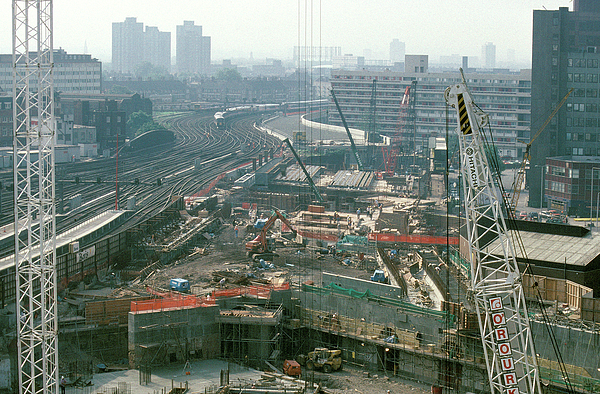
The narrative around environmental impact ties very clearly to the early railways. It was the burgeoning coal economy that provided much of the early financial impetus for railway construction, and coal remained a huge market-share of railway freight well into the twentieth century. But even beyond the coal markets so fundamental to railway operation, the environmental impacts of the new railways on the landscape were much commented upon by contemporaries. Artists were hired by various railway companies to record the process of construction, catching the Liverpool and Manchester Railway as it cut through Chat Moss, for example, or the London and Birmingham’s tunnelling works in the Midlands. These striking images are often used in traditional railway histories to emphasise the sheer scale of construction but could be easily read another way (and perhaps already are by visitors) as depictions of how immensely both rural and urban landscapes were changed.
The biggest difficulty lies in the distinction between how early nineteenth-century observers and present-day visitors discuss the environment. Although much is made of a few key sources, such as William Wordsworth’s objection to the railway’s encroachment on the Lake District, generally nineteenth century sources tended to describe the railway’s impact more in terms of ‘nuisance’. Smoke, noise, debris, crowds and altered landscapes were often mentioned in letters to newspapers, complaints to railway companies or government reports, but the medical and scientific implications of pollution – as visitors today are used to discussing – are rarely extant in historical sources. Addressing this disconnect in language is key to helping visitors understand not just the environmental impact of railways over time, but how during those times different groups have understood change in different ways.
Three new themes emerge from this analysis to place against those already in play for the Railway 200 anniversary:
| ‘Traditional’ | New |
| Impact of Railways | International Links |
| People Stories | Diversity of Voices (inc. slavery) |
| Relevance to Today | Environmental legacy of coal railway |
Reconciling these newer and older strands is, this essay argues, critical to building an engaging bicentenary programme relevant to a broader public.
Remove, retain, expand
There is always anxiety that new stories in a gallery will come at the expense of older ones. In recent years this anxiety has been felt both in relations with the public and in the critical (if not always serious) sphere of museum commentary. There has been much written about the idea that new and diverse stories might be used to ‘replace’ or ‘rewrite’ the histories of key figures, places and events, and whilst some of this has bordered on the ludicrous, written by keyboard combatants in a culture war that have deliberately misinterpreted heritage initiatives. But the pressure put on some groups and institutions, particularly Corinne Fowler and those working with her at the National Trust, demonstrate that this is not a concern that can be brushed lightly aside (Fowler). More reassuringly, the majority of concerns about changes to narrative or display come in good faith from staff, commentators and visitors worried about losing familiar and well-visited elements of a museum or gallery, rather than as part of an ideological conflict.
Change can be a big prospect for a museum or gallery. As Graham Black highlighted in the introduction to his excellent edited collection on Museums and the Challenge of Change, though, museums have always changed and must continue to do so; ‘while communicating a sense of permanence, they have actually had to renew themselves constantly as society has evolved’(Black, 2021). Whilst that process of change can be daunting for an institution, the opportunity of an anniversary should be seen as a chance to side-step some of the nitty-gritty about permanent gallery redesign and embrace new ways of working and engaging. Incorporating some of the much-needed change as identified by Black and his contributors, themselves building on previous scholarship, these railway bicentenaries must be ‘collaborative’, ‘activist’, ‘inclusive’, ‘agile’, ‘online’ and ‘participative’. Placing these alongside the interpretative threads identified in the previous sections lays the groundwork for a new bicentenary plan.
Online and agile
Audiences engage with collections in myriad ways. Even before the challenge of Covid-19 and the lockdowns that closed museums around the world, museums and galleries had been paying more attention to their online presence. Collections websites and databases have sprung up, to varying degrees of success, but so too has an often innovative heritage presence on social media platforms and video-hosting websites (Jeffries, 2021). This should not come, though, at the expense of physical content, given that many museums are seeing feedback from visitors, especially families, keen for a visit to represent time together in the real world away from ever-more intrusive personal technology like smartphones. Meanwhile agility, in Black’s text, represents fast-moving, cost-effective, easily-renewed content – ‘always something new’ (Black, 2021). Together, both elements place emphasis on the exhibit or event as something that is open, accessible and, critically, feels as new as the railways themselves were in that period.
Export and exchange dominated the early railway world. Ideas were copied from models and patterns, international visitors crisscrossed Europe and the Atlantic to see early sites and demonstrations in other countries and, hand-in-hand, engineering and investment spread around the globe. Horatio Allen, for example, visited the Liverpool and Manchester Railway whilst it was under construction, not just to meet George Stephenson and other engineers but also bearing letters of introduction to a local banking house (Gwyn, 2023). John Wesley Hackworth, the son of engineer Timothy Hackworth, was still a youth when he was sent with an early engine for demonstration in front of the Russian Tsar and his ministers on the Tsarskoye Selo Railway. Building an agile, changing display upon this basis should be achievable, not least because there will be inevitable requests to loan British railway heritage to overseas museums and galleries covering their own bicentenaries over the coming years. It is not inconceivable to imagine loans travelling both ways, with the archives and objects that tell these interconnected and international stories popping up in short exhibition format at a variety of museums and galleries.

Coupled with this agility of physical display, with small and changing exhibits of various different world railways, should come an online and interactive resource. Marsh, in her exhibition review at the Smithsonian, praised the use of an interactive map that allowed visitors to add their own sites of invention or innovation. Allowing visitors to add their own knowledge did more to communicate the exhibition’s key concept of diffuse, multiple sites of innovation than just interpretation alone would have done. Given the often-siloed nature of industrial and railway history, and that local communities frequently remain the best-connected to the former sites of industry in their area, such an online resource would help them build lines of connection and relevance between the big international or national stories and their own local narratives of the coming of the railways.
Collaborative and inclusive
This is the first anniversary of the Stockton and Darlington Railway that has no direct connection to steam power, at least for the general public. The 1875 and 1925 anniversaries took place during the period of mainline steam, whilst even the 1975 anniversary took place within a decade of steam ending on Britain’s major lines. Steam could still be found on smaller industrial railways across the country, all but the very youngest had direct experience of the steam railway, and a burgeoning preservation movement was actively seeking to keep that past alive in the public eye. By contrast, 2025 has no direct connection to draw upon. Certainly heritage railways are major visitor attractions, but for the vast majority of visitors steam is an amusing curio of the past, not an immediate and powerful part of the industrial present. Inevitably, this asks questions of just what relevance taglines such as ‘the birth of the steam railway’ or ‘the beginnings of the steam age’ has for audiences, and certainly explains why industry body Railway 200 has shifted towards a more general history of railway evolution in its interpretation of the significance of the early railways being celebrated in this anniversary. A similar shift has taken place around the discussion of freight – even as late as 1975 the railways in Britain were still heavily engaged in freight haulage whereas in 2025 the public face of the industry, at least, revolves heavily around passengers.
These shifts mean the anniversaries from 2025 onwards could build new narratives instead, moving beyond steam or casting steam in a new light, but these fundamentally require a collaborative and inclusive approach. Whilst potentially synonyms, here collaborative is taken as an internal, cross-museum focus on staff, whilst inclusive extends beyond the museum itself to incorporate visitors (and non-visitors), redesigning and expanding the legacies of the early railways in ways that are relevant and engaging. As Black argues, the participative museum must be one where ‘participation is part of the culture of the organisation in response to a public that is increasingly unwilling to accept a passive role’ (Black, 2021). That active desire is felt through industrial museums such as the NRM wherever the public come into contact with both the collections and the staff that represent them. Over the past six years of visitor feedback a consistent 65–70 per cent of visitors have expressed an interest in science and technological subjects. Comments recorded by visitor insight teams reveal, unsurprisingly, that visitors (much like the general public at large) draw links between technology and the world around them. Now, decades on from the steam and coal age that railways were born into and supercharged in turn, meeting that public interest on gallery seems vital to helping visitors engage with, for instance, those who opposed the coming of the railways in the early nineteenth century.
Industrial museums should not be reluctant to draw contemporary anxieties around technologies (diesel pollution, high rail costs, impact of major building projects) onto the museum floor where they can provide genuine foci of discussion when placed into their historical context. An early railway exhibition that showcased not just the Stephensons and Brunel but also early railway critic Dionysius Lardner or those like the poet William Wordsworth who objected to the intrusion of the railways into the rural environment, would be far more inclusive, and thus reflective, of a twenty-first century society itself divided over the impact of its own new technologies.
Collections-led and activist
Industrial museums have fabulous collections. That, of course, could be said of any type of museum or gallery, but those working in and with industrial museums will know of the special relationship between the objects in our care and the visiting public. As Fiona Candlin, Toby Butler and Jake Watts found in their exploration of the formation of smaller museums in post-war Britain, subtitled their chapter on transport museums as ‘loving objects and each other’. It would have been hard to find a more apt description, and one that I suspect extends sector-wide across transport and technology museums (Candlin, Butler and Watts, 2022). Britain’s premier place in industrial history means that its museums are often awash with incredible ‘firsts’, ‘pioneers’ and other exceptional examples that speak vividly to visitors. An anniversary is the perfect opportunity to unleash the extraordinary energy held in collections. Black contrasts ‘prioritising collections, with museum as a gatekeeper’ in his analysis with a more modern ‘prioritising use of collections with audience, including open access’, and the proliferation of online spaces for discussion and experimentation would seem the perfect opportunity for this open access to collections. The priority must be not just enhancing existing ‘collections online’ catalogues, but also allowing those engaging online to be creative with that resource in turn. Could an online public, for instance, vote for which early railway objects they would most like to see on display in the museum in a revolving, constantly updating, exhibit?
Leading with objects will not only fulfil that deep-seated desire in the visiting public for the authentic and ‘real’ in museums and galleries, but also embolden curators and other museum voices themselves. Over a decade of culture war controversy, so much of it fuelled by bad actors from outside the sector, has made museums and galleries more cautious. But with all analysis continuing to show that visitors are most persuaded by narratives rooted in the collection, regardless of their ‘political’ dimensions, curators should be more confident in centring stories around more diverse individuals and groups. As pointed out above, it was no secret that money from emancipation poured into early railways in Bristol, Liverpool and London. Returning to the object collection reveals a broader presence of early female workers, of non-white voices, and international connections beyond Europe and North America that were vital to the early railways as they grew and spread. Industrial museums must be bold and incorporate these stories into collections narratives – the renewal of an anniversary offers a perfect opportunity to do so as a ‘revision’ rather than the much decried ‘rewriting’ of history in certain sectors of the press.
In embracing this diversity, industrial museums could, and should, extend their agency outwards. They must not only aim at a diversity of stories for diverse audiences, but embrace working with those diverse agencies and activists who can retell, refocus and reflect on particular elements of the stories at play. Clearly the interest is there. The popular Kynren festival in the North East of England has, for 2025, added ‘its own heritage-style station and replica steam engine’, offering as its website states ‘the perfect pre-show photo opportunity’ (Kynren website). The inclusion of the replica of Stanhope Station, built decades after 1825 in the 1860s, would seem to support the conclusion of geographers Robert Shaw and Michael Richardson that the festival is ‘historically loose but geographically precise’ in its approach to its subject matter (Shaw and Richardson, 2022. But it is precisely that geographical precision, manifested as local pride and interest, that could be such fertile grounds for collaboration. As Kynren CEO Anna Warnecke is quoted on the organisation’s website, the Stockton and Darlington Railway bicentenary was a ‘moment in railway history [that] changed the world, and it started right here in our region and in fact just up the road from Kynren’ (Kynren website. Translating that enthusiasm into critical action is the challenge, but working with that groundswell of local interest to begin with is more promising ground than many heritage activities have at launch!
Conclusions
In its exploration of the specifics of the railway bicentenary and the issues surrounding it, this essay has attempted to explore the potential of such major public-facing events. It is important to understand the reasons why museums and other heritage bodies cling to tried-and-tested narratives, especially when the involvement of corporate or government partners leans towards positive aspects of industrial history and a sense of even-increasing ‘progress’. It is, perhaps, only natural that in a fraught present – where industrial news stories of decline, pollution and disruption tend to predominate – stories of past progress, improvement and innovation are so sought after.
This approach, as this article has shown, is not just a missed opportunity but a dangerous trend that ignores the steady evolution of museum audiences. As repeated studies and examples have demonstrated, audiences are most effectively moved and inspired by stories that reflect their concerns, experiences and passions. Stories, in short, that matter. In 2001 Colin Divall and Andrew Scott urged transport museums to reflect the then new wave of ‘social’ history sweeping museums, warning that failing to do so would render transport museums obsolete in a world that increasingly understood complex technological and historical stories through a human lens (Divall and Scott, 2001). This article has highlighted a number of ways in which industrial and transport museums could once again evolve, using the opportunity of a major anniversary to embrace both new types of narrative and new styles of engagement at the same time. With a raft of major transport and industrial bicentenaries approaching across Britain and the world now on the immediate horizon, institutions and activists must begin conversations now if they want to embrace the true potential those public events offer.
Tags
Footnotes
References
Author

Media in article