Review of Photography, Ecology, and Historical Change in the Anthropocene: Activating Archives
Article DOI: https://dx.doi.org/10.15180/252409
Abstract
Siobhan Angus reviews Photography, Ecology, and Historical Change in the Anthropocene: Activating Archives by Bergit Arends.
Keywords
anthropocene, archive, archives, Bergit Arends, ecology, Photographs, photography
Review
In Photography, Ecology, and Historical Change in the Anthropocene: Activating Archives, Bergit Arends poses two critical questions: ‘How do visual artists’ projects engage with contemporary understandings of environments and environment human relationships? And in the present time environmental crisis, what use are historic archives of places and environments?’ (p 4). Through the lens of four contemporary art projects, Arends explores how artists engage with archives – through documentary practices, critical fabulation and, notably, the ‘reperformance’ of earlier visual and ecological materials. In doing so, she offers a compelling examination of how archives can be reactivated to understand historical environmental change and to respond creatively and critically to the ecological urgencies of the present.
The first chapter lays the groundwork for Arends’s expanded notion of the archive, introducing the concept of the Anthropocene and situating this epoch of human-induced environmental transformation within environmental and artistic discourse. Arends redefines the archive – not merely as a static repository of documents and objects, but as a metaphor for memory, knowledge and epistemic production. By engaging with the materials, structures and procedures of the archive, she shows how environmental change is not only recorded, but also interpreted, transformed and contested over time. The archive, in this view, becomes an active space of knowledge production. This reorientation becomes the foundation for the book’s subsequent analysis of photography’s role in shaping and reactivating environmental histories.
A central concern of the book is the role of photography in this process. Arends treats photographs not as inert records, but as ‘photo-objects’ – unstable, contingent and interpretive artefacts that can be re-performed by artists to engage with the past, present and future. This reframing of photographic and archival materials as dynamic agents underpins a broader methodological argument: that art, and particularly photography, plays a vital role in exposing and reimagining the layered relationships between history, environment and human intervention.
Following this theoretical framing, the book presents four richly contextualised case studies. Chapter two focuses on the coal-mining landscapes south of Leipzig during the German Democratic Republic, through the work of Nguyen The Thuc and Christiane Eisler. Nguyen’s Kohle unter Magdeborn (1977–78) documents the devastation caused by open-cast coal mining, while Eisler’s recent photographic responses in Freundschaftsantiqua (2014) form a dialogue across decades. Together, their work highlights how archival photography can catalyse critical conversations about environmental degradation and socio-political histories. Here, Arends gestures to a broadened concept of an archive, expanding it beyond traditional object or document collections to include the environment itself and the human body. The idea of landscape, geology, the body, and the environment as living archives is particularly compelling. Further exploration of this concept holds great potential, fostering interdisciplinary dialogue by examining how the Anthropocene necessitates a re-evaluation of human-centred ways of thinking.
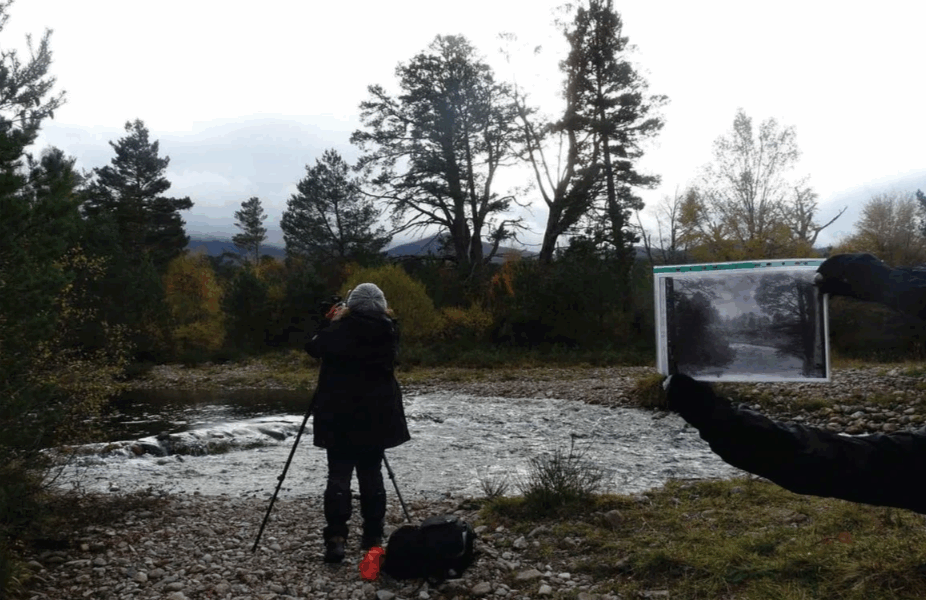
Chapter three turns to Chrystel Lebas’s reactivation of the photographic archive of early twentieth-century ecologist Edward James Salisbury, who documented British plant habitats. In collaboration with botanist Mark Spencer, Lebas reinterprets these images to challenge colonial and Eurocentric narratives of nature and demonstrate the evolving nature of ecological knowledge. Arends introduces three distinct perspectives – that of a historical ecologist, contemporary scientists and a contemporary artist – to examine the multiplicity of ways we perceive and represent landscape. Through this triangulated gaze, she outlines a ‘visual framework’ rooted in collaborative ways of seeing that foster dialogue between art and science.
Chapter four examines Mark Dion’s A Yard of Jungle (1992), a re-staging of American scientist William Beebe’s early ecological fieldwork in Brazil. Undertaken during a residency with the Arte Amazonas project and presented at the 1992 Rio Earth Summit, Dion’s project interrogates both historical and contemporary practices in environmental science and conservation. Through the ‘reperformance’ of archival fieldwork, Dion foregrounds the epistemological and political foundations of ecological research, framing the Anthropocene as a crisis of both environment and knowledge production.
Chapter five analyses Seeds of Empire: A Little or No Breeze, a collaborative exhibition by photographer Joy Gregory and composer Philip Miller. Revisiting the seventeenth-century journals of Hans Sloane – a physician working on a Jamaican plantation – Gregory and Miller focus on Sloane’s observations of Rose, an enslaved Black woman, to expose the colonial legacies embedded in historical environmental data. Reinterpreting these records from a contemporary British perspective, the artists reveal the entanglement of colonial power, environmental exploitation and knowledge production. The project illustrates how archives can reflect and perpetuate historical power structures, while also serving as sites for reimagining environmental justice.
Arends’ emphasis on methodologies of return – or what she terms ‘reperformance’ – offers a compelling and thought-provoking approach that treats the act of revisiting the past as a method in itself. This framework underscores the idea that understanding the present, particularly the crises of climate breakdown, requires a critical engagement with the historical processes that shaped it. The temporal oscillation between past and present not only animates the case studies but also provides a cohesive thematic thread that connects the diverse projects examined in the book.
Throughout the book, Arends foregrounds the importance of fieldwork, embodied engagement with landscapes, and collaboration with artists. In her role as curator of contemporary art at the Natural History Museum, she facilitated the collaboration between Chrystel Lebas and Mark Spencer, demonstrating her own investment in curatorial praxis as a form of research. Her personal field observations lend additional depth to the book’s analyses, grounding them in material encounters with ecological sites. This emphasis on collaborative, cross-disciplinary engagement highlights the affective and transnational dimensions of environmental change and reinforces the book’s central argument: that the archive – when activated by artists – becomes a critical site for challenging dominant narratives and imagining new ecological futures.
Arends’s interdisciplinary approach – drawing from curatorial studies, historical geography, art theory and environmental studies – offers a nuanced account of how contemporary artists both respond to and shape understandings of the Anthropocene. Photography emerges not simply as a means of representation, but as a participatory method for intervening in environmental knowledge. The book’s methodological innovation lies in its capacity to bridge disciplines and scales, from intimate field observations to global environmental discourses.
Photography, Ecology, and Historical Change in the Anthropocene: Activating Archives is a rich and intellectually generative text. Its interdisciplinary scope ensures its relevance for scholars in art history, photography, environmental studies and curatorial practice. By reconceiving the archive as a living, relational and performative site, Arends offers a powerful argument for the role of contemporary art in both critiquing and reimagining the environmental crises of our time.
Tags
Author

Media in article