Silence in the collections – revealing science stories through Indigenous partnership
Article DOI: https://dx.doi.org/10.15180/252406
Abstract
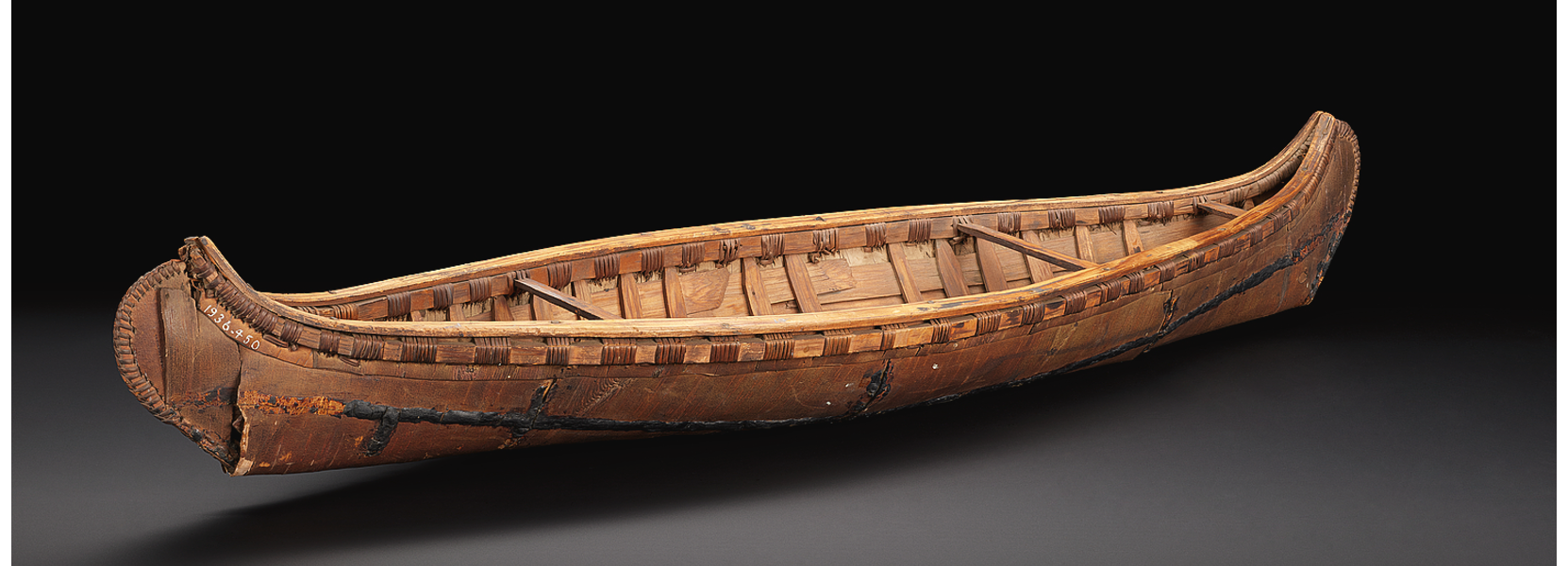
This article reveals the transformational value of Indigenous partnership for understanding the science stories within our collections. Indigenous objects are often poorly catalogued in the collection, with vague descriptions such as, ‘perhapes [sic] prepared by Canadian Indians’[1] belying provenance and worse, obscuring the scientific and technological contributions of Indigenous Nations. In this article, Hartman Deetz, a Wampanoag arts and education consultant and tribal citizen, and Milly Mulcahey-Knight, a white, non-Indigenous anthropologist and research assistant at the London Science Museum, collaboratively interpret two objects made of birchbark in the care of the Science Museum Group (SMG). The first is a collection of five pieces of maple sugar, stored in individual conical containers of twisted birchbark.[2] The second is an intricately designed model birchbark canoe.[3] Starting with vague catalogue descriptions, Hartman and Milly detail the use of the maple sugar as a medicinal plant, connected with other medicines and medical technologies in the collection. The model canoe is interpreted as a teaching tool for Ojibwe-style birchbark canoes which turned riverways into transport routes for trade and cultural exchange. This ingenious use of the flexible and waterproof birchbark also left its mark on London. As a central technology of the beaver trade, these canoes were profited off by London’s elite and even remembered in the architecture of Oxford Street.
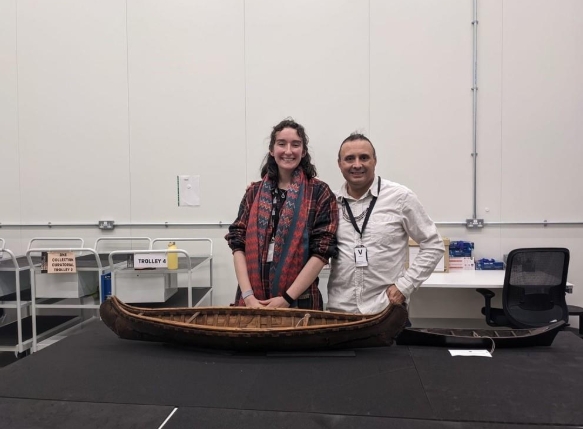
The research described took place during the planning of an exhibition at the London Science Museum on Science and Technology in North America in the mid-1700s. Milly and Hartman joined the team as the curators transitioned from a two-year-long research stage into exhibition planning. Hartman acted as a paid independent cultural advisor. Milly was on a four-month placement funded by the White Rose Consortium as part of her PhD research into Indigenous and non-Indigenous partnerships in heritage work. In partnership they identified objects and interpreted Indigenous science stories, to enrich the exhibition and collections interpretations. Overall, this article demonstrates that collaborative interpretation with Indigenous experts not only adds detail to the SMG and Wellcome Collection catalogues but challenges the silencing of Indigenous contributions to science and technology.
Keywords
birchbark, canoe, colonial history, colonialism, craft, craft science, Indigenous, Indigenous partnership, Wampanoag
Introduction
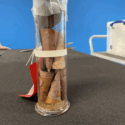
https://dx.doi.org/10.15180/Through a collaborative partnership, Hartman Deetz, a Mashpee Wampanoag activist and cultural consultant, and Milly Mulcahey-Knight, a white, non-Indigenous anthropologist and research assistant at the London Science Museum, reveal the vast but underexplored interpretive potential of two birchbark objects. The first object is a curious collection of five small portions of maple sugar stored in individual conical containers of twisted birchbark[4]; the second is a beautiful, lightweight and intricately designed model of a birchbark canoe.[5] The former is part of Sir Henry Wellcome’s Museum Collection, on long–term loan to the SMG, and the latter is part of the SMG’s permanent collection. Both are housed in the Hawking Building, one of the vast hangers of the former RAF base, now the SMG collections management facility at the National Collections Centre. The catalogue reveals very little about these objects; for the unusual maple sugar containers, it reads, ‘Jar of maple sugar in birch-bark perhapes[6] [sic] prepared by Canadian Indians, Canada, dated 1870’.[7] From these descriptions we cannot interpret which Indigenous Nations made these objects, how they were engineered, their intended use, or their cultural and historical significance. Furthermore, these archival gaps perpetuate a colonial and settler-colonial silencing of Indigenous Nations’ culturally diverse and significant contributions to science and technology. By revealing the medicinal characteristics of sweet maple sugar, and by following the canoe’s journey through the meandering waterways of North America and ultimately into a British national museum, we reveal a powerful story of Indigenous diversity, ingenuity and continued presence in North America and Canada.
In the collections, searching for canoes – Milly
I was conducting research for an upcoming exhibition at the Science Museum, which will interpret the rich and competing science and technology stories of 1700s America. I had introduced Hartman to the Science Museum team during the research stage of the exhibition’s development. I know Hartman well through my heritage work and PhD research. We had worked together at a US museum ten years ago, and during a recent Nottinghamshire (UK) museum partnership with the Wampanoag Nations. I have also interviewed Hartman many times for my PhD research examining the emotional experiences of Indigenous and non-Indigenous partners in heritage sites in England, Turtle Island (in the USA) and Aotearoa (New Zealand). The Science Museum curators invited Hartman to become a paid independent cultural advisor on Indigenous content. As Hartman was already in England working on another heritage project, the curators organised a trip to the Museum’s National Collections Centre in Swindon. Hartman was asked to provide insights on objects in the collection which had been selected by the curators and myself as relevant to the upcoming exhibition. His expertise was sought to improve both the exhibition and collection interpretation.
Navigation had been identified by curators as a key theme for the exhibition. They had begun researching the merchant and military vessels that connected Britain to the American colony but I knew that America has a rich navigation history far preceding colonisation. In Alice Te Punga Sommerville’s influential essay, ‘“I do still have a letter”: Our sea of archives’, she begins with the reflection that, ‘There are as many stories about archives as there are stories kept inside them’ (2016, p 121). My story extended the curators’ ideas of navigation and connected them to the canoes in the collection and to my friend Hartman. As part of his work with Turtle Island Museum in the US, Hartman and his colleagues built mishoonash, traditional dugout canoes. To construct this hardy, seaworthy vessel, a felled tree is expertly hollowed out using a controlled fire, over several days. Historically, mishoonash held up to forty people and would be used for fishing and navigating the waterways between Wampanoag Nations on the east coast. Through my work at the US museum, I had already experienced the canoe as a site of knowledge sharing, around which members of different Eastern Woodlands Nations discussed the waterways, traditional crafts and their responsibility to protect them. The mishoon is also part of the story of my friendship with Hartman. I once drove him and his family to a traditional clambake event because his car was immobilised by the huge mishoon he had strapped to the roof. As Sommerville describes, I brought these experiences to the Collections database and they shaped what I found. I chose to search for ‘water transport’ and added the names of specific North East Indigenous Nations – ‘Wampanoag’, ‘Algonquin’ and ‘Ojibwe’ – yet this returned few or, in many cases, no results. Eventually, I conceded to searching for ‘North American/Indigenous’ and got a long list of model canoes, medicinal objects and beaded bags from across the Americas. I felt the familiar wave of discomfort at the settler-colonial homogenising of Indigenous identity that had resulted in the pooling of these culturally distinct objects. In searching this collection, I also, as Sommerville predicted, encountered an unexpected ‘sea’ (2016, p 121) of interconnected relations, including not only the listing of the birchbark canoe, with a fuzzy documentary photograph, but the curious entry of maple sugar stored in birchbark. The collection, in its present state, offered a limited foundation for independent research by non-Indigenous interpreters. To interpret these diverse objects, brought together by vague labels, we would need Hartman to draw on knowledge beyond his personal experience as a Mashpee Wampanoag person. We would be relying on Hartman’s broad understanding of culturally distinct Indigenous Nations, their histories and material cultures.
Visiting the National Collections Centre – Hartman
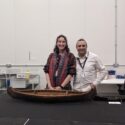
On the day we visited the Collections Centre, I had only met my colleagues from the SMG over Teams, from my home in Boston, Massachusetts. Arriving at the London train station, I looked for familiar faces and soon found Elissavet Ntoulia, Curator of the upcoming SMG exhibition on science and technology in North America in the mid-1700s, and Sarah Bond, Curator of Medicine at the Science Museum. I introduced myself and my partner Katarzyna Wosiak, Collections Manager at the Bassetlaw Museum in Nottinghamshire. We had met during a similar interpretive partnership in 2021, where my cousins and I had built a traditional Wampanoag home on the English museum’s grounds and interpreted shared Wampanoag and English colonial history. Through that project I had also worked with Milly, who in turn introduced me to the SMG.
After the hour-long train journey, a taxi brought us to the security gate of the Collections Centre, housed in a repurposed Royal Air Force base. Here at the security checkpoint, we got our temporary access badges and met with Milly who drove us down the old runway. Finally, we made it to the new, purpose-built collections building, a cavernous facility with a vast collection of science-related artefacts: old ceramic jars full of Chinese herbs, hundreds of computers and telephones, distillery equipment, even a Dalek, and Steven Hawkin’s office furniture. The space was reminiscent of the storage facility in Raiders of the Lost Ark (Spielberg, 1981), where the Ark is crated and wheeled away, presumably to be lost again among the millions of objects – out of sight and out of mind.
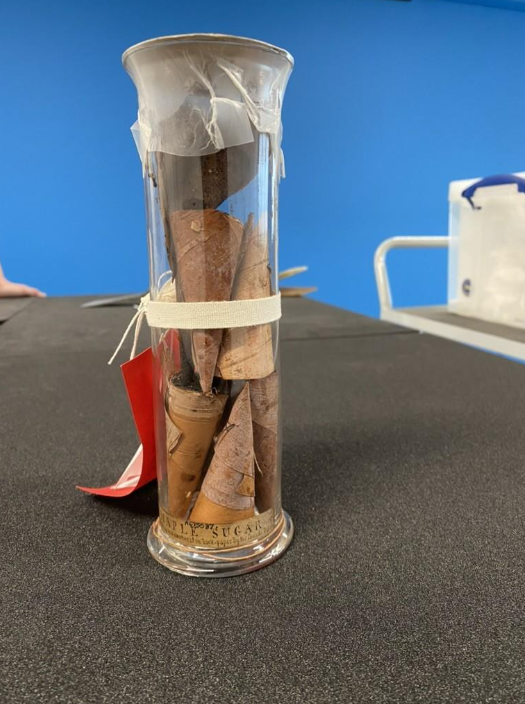
My task for the day was to serve as a Native cultural consultant for objects selected by Milly and the SMG staff. The first of them to catch my attention was a glass jar about a foot tall, full of carefully curled cones of birchbark filled with maple sugar. Like the other items I would advise on, this had slim notes about its significance. Vague labels and incomplete information in the catalogue are certainly a part of what one expects to find in any museum collection, especially in older items or acquisitions from private collections. We cannot expect records to reflect the detail we want in today’s academic standards. However, with Native American collections, European assumptions and dismissiveness about the validity of the sciences of Native people, even into recent times, have left little exploration into Indigenous tools and medicinal objects stored in museums. Whereas records of other collection items are often supplemented or updated with new and advancing bases of knowledge, the vast scientific knowledge of Native American people has been too often relegated to the realm of superstition or mysticism. Looking at the glass jar, I could quickly share that both maple and birch are medicine plants; maple sugar was used for coughs and intestinal issues, as well as a kidney cleanser and liver tonic; birch was used for joint pain, kidney and bladder stones. Native knowledge has made huge contributions to medicine, through pharmaceuticals, surgeries and devices such as the first syringe, made with a hollow bird bone needle and a bag made from animal bladders.
One of the items I spotted on the shelves as we walked through the collections facility was a large plaster casting of a Native American person performing surgery on a patient, sucking out disease by means of a bone tube.[8] Slim collection notes seem to correspond with shifting attitudes towards Native medicines, and their validity. For centuries, Native people have faced dehumanisation and the violent systematic oppression of our cultural pedagogy through boarding schools, forced relocation and religious conversion. Much of our own knowledge has been lost to the generations. What has survived is now being sought after as Traditional Ecological Knowledge (TEK); knowledge that is often deeply rooted in place and gained through interactions with the natural environment, including practices such as hunting, fishing and gathering natural resources. Being displaced from a traditional homeland can often sever a people’s connection with the learning experiences of their cultures. Viewing medical contributions through a modern lens, we can see that Native contributions have been immense. Western medicine has since confirmed that maple sugar has antioxidants and anti-inflammatory properties as well as cancer-combating proteins called phenolic compounds. Much like a foil tablet container, the carefully twisted birchbark was perhaps used to pre-prepare and transport the maple sugar. Maple sap comes out of the tree as a comparatively thin liquid before it is boiled and reduced, and even as it solidifies it stays sticky for months. The birchbark seems to be an ingenious solution to allow the maple sugar to be transported and used. I am happy to see this new trend of the science community, as well as the museum community, turning to Native people to include our voices and what knowledge we do retain. Museum collections will be enriched by the new understandings that derive from a worldview that focuses on intersectionality and connectedness as opposed to the European approach of classification and categorisation. These vastly different approaches to scientific inquiry are bound to produce different understandings. The world will be the better for it, when we can learn from each other.
Turning to the birchbark canoe – Hartman
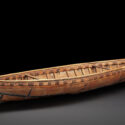
The model canoe was stunningly beautiful. Despite being little more than a metre long (104.5cm), no detail was spared, from the paddle to the pitch, the splint gunnels to the spruce root lashings. Often when models are created in miniature, details get left out. Birchbark is a material that could have taken shape with the simple addition of some thwarts to open the centre and stitching on the nose. A simple toy, an item for a child, does not need to be watertight or bear the load of transporting goods for trade over the water. But here we had a miniature complete with gunwales, ribbing and planks, and even a small, intricate headboard. All of the spruce root stitching is even and tight and the seams on the birchbark are sealed with pitch. Every step, every detail of a full-sized functional canoe was put into this model. I think it is therefore likely that this model was intended as a teaching tool, to pass on knowledge for the making of the full-sized vessels. The combination of the bark covering and the cedar planking reinforcement make the full-size vessels light and flexible, but still durable enough to withstand most casual bumps and collisions from rocks and logs in the riverbeds. The cedar planks are layered on like scales between the bark and the ribs so they can provide strength without being overly rigid. Distinct styles and methods of constructing the headboard and the shape of the bow and stern can also help identify the makers of the canoes (McPhee and Adney, 1975). This model seems to be of an Ojibway style, whose territory stretches from Quebec to Saskatchewan, on the US side of the border, from Niagara falls to North Dakota (McPhee and Adney, 1975, p 20).
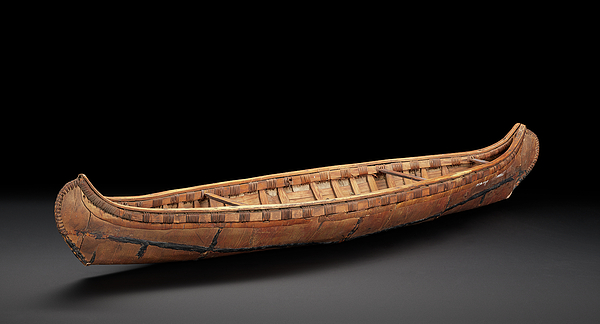
A story of cross-cultural exchange and colonisation – Milly
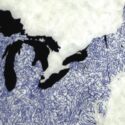
As the Collections Access Facilitator unwrapped the canoe, they exclaimed, “it is much lighter than I expected!” The same quality of birchbark also surprised French colonists in the 1500s. As the French sailed into the St Lawrence Gulf, European colonists were confronted with the superiority of these lightweight craft for inland travel. The birchbark canoe was engineered by Northern tribes in Maine and the Great Lakes for navigating rivers and inland lakes. Made of this lightweight, waterproof and flexible material, the birchbark canoe could hold a heavy load, but remain light enough for a person to portage. This navigation technology opened routes for vast networks of intertribal trade. Professor of English and American history at Amherst College, Lisa Brooks mapped the Northeast waterways to highlight the interconnection of Indigenous Nations, which is often obscured by state boundaries.
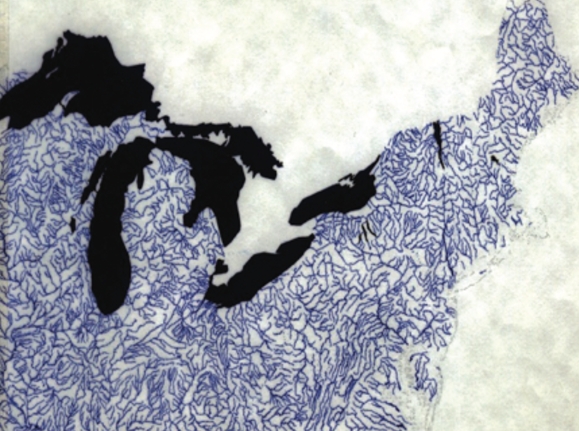
In Associate Professor of History at Georgia Southern University, T Kurt Knoerl’s study of the eighteenth-century use of the birchbark canoe, he explains that these waterways were so numerous that a voyager ‘could cross almost the entire continent utilizing portages of less than ten miles between bodies of water’ (2022, p 288). Indigenous water transport and navigation technologies connected cultures, enabled trade and were exploited as tools of colonial domination and Indigenous resistance.
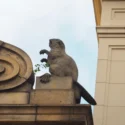
The birchbark canoe enabled the explosion of the beaver trade across Northeast America and Canada from the sixteenth through to the nineteenth century. Sold into Europe for the making of hats, the sale of beaver skins bolstered colonial economies. In this way the birchbark canoe, and the ‘Indigenous knowledge and labour’ (Thrush, 2016, p 257) driving it, connects to London earlier than SMG’s 1936 acquisition of the model canoe. On Oxford Street is a red-brick Victorian building, the Henry Heath Hat Factory, which is still topped with beautifully carved beavers.
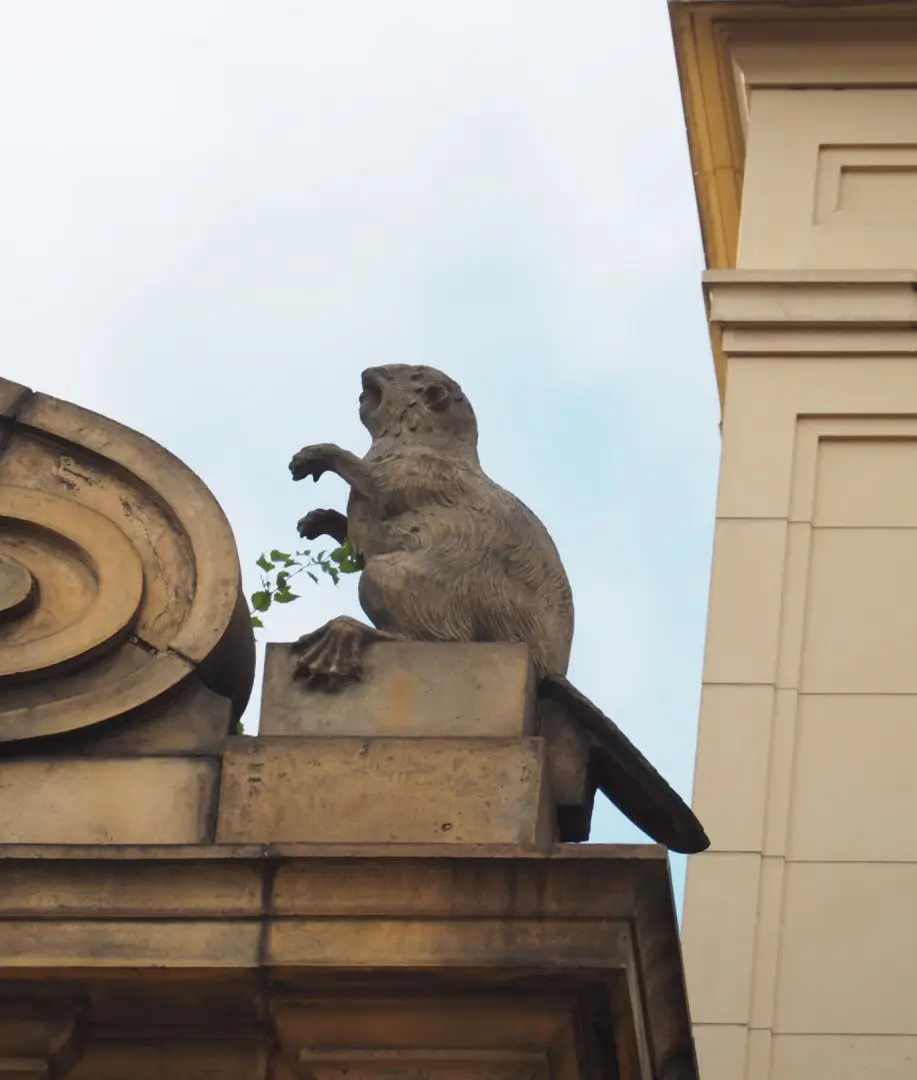
Professor of History at the University of British Columbia, Col Thrush, pens a poem to the beavers of Oxford Street in his work, Indigenous London, drawing out the connection between London and Indigenous America:
‘A Hat Factory’, circa 1875
Above a sea of chimneypotted and stovepiped men,
Four gargoyles perch in the Oxford Street skyline.
Neither lions nor demons nor saints: beavers. They look down from
Henry Heath’s factory, where seventy men sew and block
Victorian manhood.
Newly carved and ensconced, the beavers are already epitaphs
To a dwindling trade, with styles already turning to silk,
As arteried waters go bereft of furbearers,
As long chains stretching from the city
To the lands of the Ojibwe and Cree and Dene
Creak under fashion’s appetite.
Thrush, 2016, p 169
Following the canoe from the harvesting of the birchbark through the winding waterways, to the doomed beaver, is both a journey through Indigenous America and Colonial London. Knoerl argues that we can interpret the contested and fast-moving history of the eighteenth-century colonisation of Canada and North America just from the vantage point of the birchbark canoe (2022, pp 286–305). Following the canoe, we examine ‘practical everyday interactions [of its users]’ and ‘we gain a new perspective on how empire plays out at a local level’ (Knoerl, 2022, p 303). What is revealed is a more complex picture of British-Indigenous interactions. Indigenous peoples and merchants alike used these vessels to ‘frustrate the army’s attempts to control’ them, with English merchants trading deep within the spaces of Indigenous power (Knoerl, 2022, p 303). Despite the deeply entwined histories of England and Indigenous North America, Col Thrush stresses that there is a profound absence of public knowledge in the UK (Thrush, 2016). Indigenous heritage partners, therefore, often take on the emotional labour of educating and guiding their British partners to critically engage, often for the first time, not only with Indigenous histories but their own British colonial histories. Just as the carefully engineered birchbark canoe made accessible the waterways of North America for a vast trade between Indigenous and Colonial Nations, by improving the catalogue of this small model canoe, we can make accessible complex and contested Indigenous and British colonial histories.
For Indigenous people today – Hartman
For Indigenous people today both maple sugaring and canoe making continue to be important parts of cultural education. Where tribes have many and diverse stories relating to these products and processes, the natural sciences are the same across the board. The pedagogy of Indigenous knowledge is intersectional as opposed to western systems that focus on categorisation and classification. While classification is certainly important in identifying the tree you seek to harvest from, the knowledge continues to branch out like the trees themselves. In addition to the use of the birchbark for the canoe, there is the need to identify and harvest cedar, spruce roots and pine pitch. Each of these resources will also be found in their own microenvironment.
Both maple sugaring and bark harvesting rely on seasonal changes and sap flow. In the spring the sap flows up from the roots, and in the fall the sap flows down from the branches. During these two seasons the cambium of a tree fills with sap and creates a lubricated layer that allows bark to separate easily from the wood in large sheets. For the maple sugar this sap is what is harvested and boiled to create a reduction of maple syrup or even further to create the solid maple sugar we see stored in the birchbark cones. When you go to gather medicine plants you are taught ceremony, to make offerings to the plants as part of our cultural continuity and survival, but also about the medicines themselves. In harvesting from the environment, you will likely encounter other medicinal plants that could be potentially of immediate use, such as Jewelweed whose sap is used as a topical treatment for the rash of Poison Ivy, or Sweet Fern with its many benefits for the lungs and skin as well as an insect repellent.
While the physical process of tapping maple for harvesting the sap is simple, it still requires the use of tools, a knife, a drill and a mallet. The process of constructing a canoe will require wedges, axes, draw knives, crooked knives and froes. Pieces of the frame are made using precision-finish carpentry, selecting the appropriate grain. The whole process will also employ joinery, stitching, steam, lamination, tension and leverage. Clamping will be achieved using twisted rope, and a mixture of animal fat and tree sap will be used to laminate the birch bark to the cedar planks. This mixture allows for another amazing quality of the birchbark canoe: the ability to self-heal. When cracks or tears occur to the outer bark layer the canoe can be turned bottom up and exposed to the sun where the warmth will re-melt the fat/sap mixture and fill in the damage to the outer layer of birchbark. The stitching on the bark is coated over with a product that is a mixture of pitch, fat and charcoal. The addition of carbon fibre from the coal helps to prevent the pitch glue from shattering.
The hours of boiling sap to syrup are also important times for the sharing of cultural stories, songs and histories. Likewise, when the finished product of the canoe is put into the water there is time for learning stories, the skills of canoeing, the ecosystem of the waterways and the geography of the land. Canoe travel was the traditional means of connecting communities for trade and often diplomacy as well. Many tribal communities are starting to re-engage with traditional diplomacy practices through intertribal canoe events.
In conclusion
The SMG, like other British museums, has begun the work of reckoning with its colonial history, acknowledging silences in the catalogues that have been preserved through the exclusion and misrepresentation of Indigenous communities. The partnership between SMG and an Indigenous cultural consultant described here illuminates the complex science and technology stories obscured by the vague current cataloguing of the birchbark–wrapped maple sugar[9] and the model canoe.[10] Hartman’s insight added detail to the collection record: that maple sugar and birchbark are medicinal objects and that the canoe was an Ojibwe design and perhaps used as a teaching tool. Furthermore, we have revealed the vast interpretive potential of these birchbark objects, showing their significance within Indigenous and colonial history. Crucially, Hartman’s visit marks not the end but the beginning of a committed process of learning and knowledge sharing, which will enrich SMG’s collections and public exhibitions.
Tags
Footnotes
References
Media in article